
Rome: A City of Extremes – The Eternal Derby
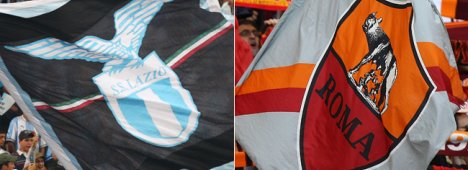
Image source here credit to Digital-News.it
This article presents a historical perspective on the complex social and political dynamics that have shaped Rome’s football culture over the decades. As with all aspects of society, these dynamics have evolved and continue to change over time.
Rome is a city of extremes. Are you Roman? Then you are either red or sky blue, wolf or eagle – there is no place for gray areas or middle ground here.
The capital is divided both athletically and politically, and this division is embodied in the two teams: Roma and Lazio, along with their passionate supporters.
The Birth of a Rivalry
In 1927, Italo Foschi, secretary of the Italian Fascist Party, wanted to create a strong southern club to challenge the dominance of powerful northern clubs over Italian titles. Foschi was an important Roman representative of the ruling National Fascist Party AS Roma – Wikipedia who initiated the merger of three clubs from the capital to form AS Roma: Roman FC, SS Alba-Audace, and Fortitudo-Pro Roma SGS. The purpose of the merger was to give the Eternal City a strong club to rival that of the more dominant Northern Italian clubs of the time. However, Lazio, which had been founded 27 years before this merger, refused to join this new entity. In 1927, Lazio was the only major Roman club which resisted the fascist regime’s attempts to merge all the city’s teams into what would become Roma the same year WikipediaKiddle, largely thanks to the intervention of Giorgio Vaccaro, a general in the fascist regime who defended Lazio’s right to maintain its independence.
The Ancient Roots
Società Podistica Lazio was founded on 9 January 1900 in the Prati district of Rome, making it not only older than Roma but also the oldest Roman football team currently active. When SS Lazio was founded, its original founders settled on the team colors of white and sky blue in order to pay homage to Greece, the homeland of the Olympics SS Lazio football club history. The club began as a multi-sport organization, with football being added as an additional discipline in 1901, still little known in Rome in terms of its details and rules of play S.S. Lazio | Storia del Club.
Two Sides of the Same City
The supporters of the newly formed Roma quickly considered themselves the rightful heirs to the city (as they formed and continue to form the majority). They adopted the traditional symbols and colors of Rome: the wolf – emblem of Mars, god of war and father of Romulus and Remus, the city’s founders – along with the red color of the Roman Empire. Roma was associated with the working class A brief introduction to Rome’s football Derby: SS Lazio VS AS Roma after settling in the working-class neighborhood of Testaccio in Southern Rome. Roma’s fanbase has traditionally been centered in working-class areas, predominantly from the suburbs and poorer districts, with left-wing political leanings and opposition to global capitalism.
Lazio’s emblem and colors, meanwhile, were inspired by Zeus, the sky god in Greek mythology. Their symbol is the eagle and their color is the blue of the sky. The neighborhood of Prati in the north of the city where Lazio was founded has traditionally been a prominent upper-class area of Rome. This led to Lazio being considered a club mostly for the bourgeois in their early years A brief introduction to Rome’s football Derby: SS Lazio VS AS Roma. Historically, the largest section of Lazio supporters in the city of Rome has come from the far northern section, creating an arch-like shape across Rome with affluent areas such as Parioli, Prati, Flaminio, Cassia and Monte Mario SS Lazio Facts for Kids.
The Political Divide Deepens
The political tensions between the fan bases became particularly pronounced through their organized ultra groups. This was encapsulated by the ideology of the duo’s most renowned and now disbanded Ultrà groups, the ‘right-wing’ Irriducibili of Lazio’s Curva Nord, and Roma’s ‘left-leaning’ Commandos Ultrà Curva Sud (CUCS) Divided and united: The paradoxical politics of the Rome Derby –. Lazio has one of the most notorious fascist followings of any team in Europe, caused by drawing much of its fan base from the Rome suburbs and the connected countryside – areas of strong support for Benito Mussolini back in the 1920s and 1930s The Ultras – HOPE not hate.
The extent of this political extremism became evident in disturbing displays. In a derby in the late ’90s, the Lazio fans brought a special 160 foot banner to display to their crosstown rivals. It horrifically read: “Auschwitz is your town, the ovens are your houses.” Why Roma-Lazio Is One of World Football’s Fiercest Rivalries Most notably, at a derby of the season 1998–99, laziali unfurled a 50-metre banner around the Curva Nord that read, “Auschwitz is your town, the ovens are your houses” SS Lazio supporters – Wikipedia.
Moments of Controversy
In a 2005 derby, Lazio star Paolo Di Canio celebrated his goal against Roma by giving the fascist salute to Roma supporters. He scored in the Rome derby, just as he had in 1989, leading the team to a 3–1 victory over Roma on 6 January 2005 Paolo Di Canio – Wikipedia. Lazio striker Paolo Di Canio is being investigated by the Italian federation after images showed him celebrating Thursday’s 3-1 win over Roma with a fascist-style salute CNN.com – Di Canio investigated over gesture – Jan 8, 2005. Di Canio later stated his position clearly: “I’m a fascist, not a racist” ‘Fascist’ Di Canio polarizes opinion and defended his actions, saying “I will always salute as I did because it gives me a sense of belonging to my people” Paolo Di Canio – Wikipedia.
The Ultra Culture
Particularly intense or fanatical fans are referred to as Ultras. The term originated in Italy in reference to the anti-social behaviour of Roma and Lazio fans Rome’s biggest rivalry. “We don’t want to talk about football. We are more interested in fighting! We are ultras – we are not fans” Inside Lazio’s ultras: on the ground with Italy’s most notorious fans | FourFourTwo, explained one Lazio ultra, capturing the militant mentality that defines these groups.
An Unlikely Common Ground
Paradoxically, both Roma and Lazio supporters display Palestinian flags and support the Palestinian cause – but each for their own reasons. Roma fans do so due to their opposition to global imperialism, while Lazio fans do so because of their anti-Semitic views. There is, however, a paradoxical dimension to this derby. A form of fan politics that has seen the Ultras of Roma and Lazio transcend their mutual hatred and unite in protest against what they consider the systematic oppression of their world and culture Divided and united: The paradoxical politics of the Rome Derby –.
Violence and Tragedy
In 1979, father of two, Vincenzo Paparelli attended the derby with his wife. While they waited for the game, Lazio and Roma fans traded the usual insults, and Roma fans fired two nautical flares towards Lazio fans. A third flare however launched directly into the crowd and hit Paparelli directly in the eye. He immediately slumped over, and bystanders were unable to save him Rome’s biggest rivalry. This tragic incident highlighted the dangerous extremes to which the rivalry had escalated.
The Modern Reality
Neither club enjoys a particularly large fanbase outside of the city. And with neither team having achieved too much success in the league, the derby becomes the most important game of the season Why Roma-Lazio Is One of World Football’s Fiercest Rivalries. Combined both clubs have won just over 30 trophies in their history. To put that into perspective, Italian giants Juventus have won 36 league titles alone, while Roma and Lazio have just five between them A brief introduction to Rome’s football Derby: SS Lazio VS AS Roma.
The Derby Della Capitale
Today, you will witness one of the most violent and dangerous football matches in the world – a clash that embodies centuries of history, politics, and passion in the Eternal City. It is amongst the most heated and emotional footballing rivalries in the world SS Lazio Facts for Kids, where winning the derby becomes a step closer to winning the city. Sport becomes an eternal military campaign Why Roma-Lazio Is One of World Football’s Fiercest Rivalries.
DISCLAIMER: This post is shared purely for educational and cultural understanding purposes. The author does not endorse, support, or agree with any political positions, actions, or viewpoints mentioned herein. The content is presented to foster cross-cultural awareness and historical understanding of complex social and political issues.
